2021
Themes and Variations: Topics from Print Council of America — Art and the Pull of Print; A Conversation
Watch the recording (opens in a new tab)
Speakers
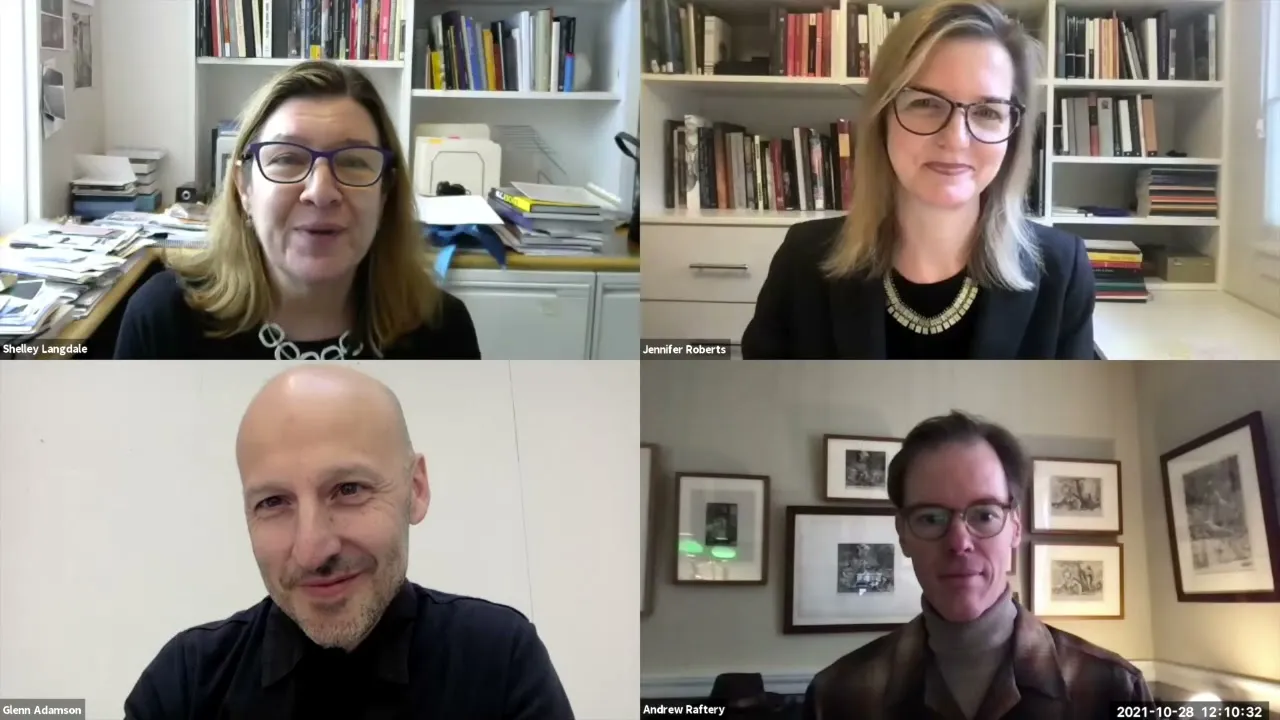
- Jennifer L. Roberts — Elizabeth Cary Agassiz Professor of the Humanities, Harvard University
- Glenn Adamson — Curator and writer
- Andrew Raftery — Artist
- Shelley R. Langdale — Moderator — Curator and Head of Modern Prints and Drawings, National Gallery of Art
How might we more fully consider the physical operations of printmaking as contributing to the conceptual, metaphorical, and visceral implications of prints as works of art?
Jennifer Roberts provides an overview of her recent A.W. Mellon lectures Contact: Art and the Pull of Print, and then discusses, with Raftery and Adamson, the ideas set forth in the lectures.
What would it mean to consider contact rather than reproduction as the essence of print? To argue that printmaking drives, rather than derives from, innovation in other media? To imagine that the processes of printmaking, its nuanced way of facing up to the factual, encourage a way of seeing the world that is urgently needed today?
*Jennifer L. Roberts* is the Elizabeth Cary Agassiz Professor of the Humanities at Harvard University. She is a scholar of American and British art from the 18th century to the present day. Her work approaches the history of art through its intersections with print history, material studies, the theory and practice of making, and the history and philosophy of science.
*Glenn Adamson is a curator and writer who works at the intersection of craft, design history and contemporary art. He has previously been Director of the Museum of Arts and Design; Head of Research at the V & A; and Curator at the Chipstone Foundation in Milwaukee. His most recent book is Craft: An American History*, published by Bloomsbury in 2021.
*Andrew Raftery* is an artist specializing in both fictional and autobiographical narrative scenes of contemporary American life. Known for his paintings, burin engravings and drawings, Raftery has developed a particular interest in prints for their ubiquitous role in our world: on wallpaper, clothing, and functional objects. His artistic practice is heavily research-based as a curator and collector, and it is both personal and objective, a constant self-reflection informed by historical research on the democratization of mediums.