Zhang Yunyao When the Surface Thinks
October 30 – December 18, 2026 · Hong KongOn view
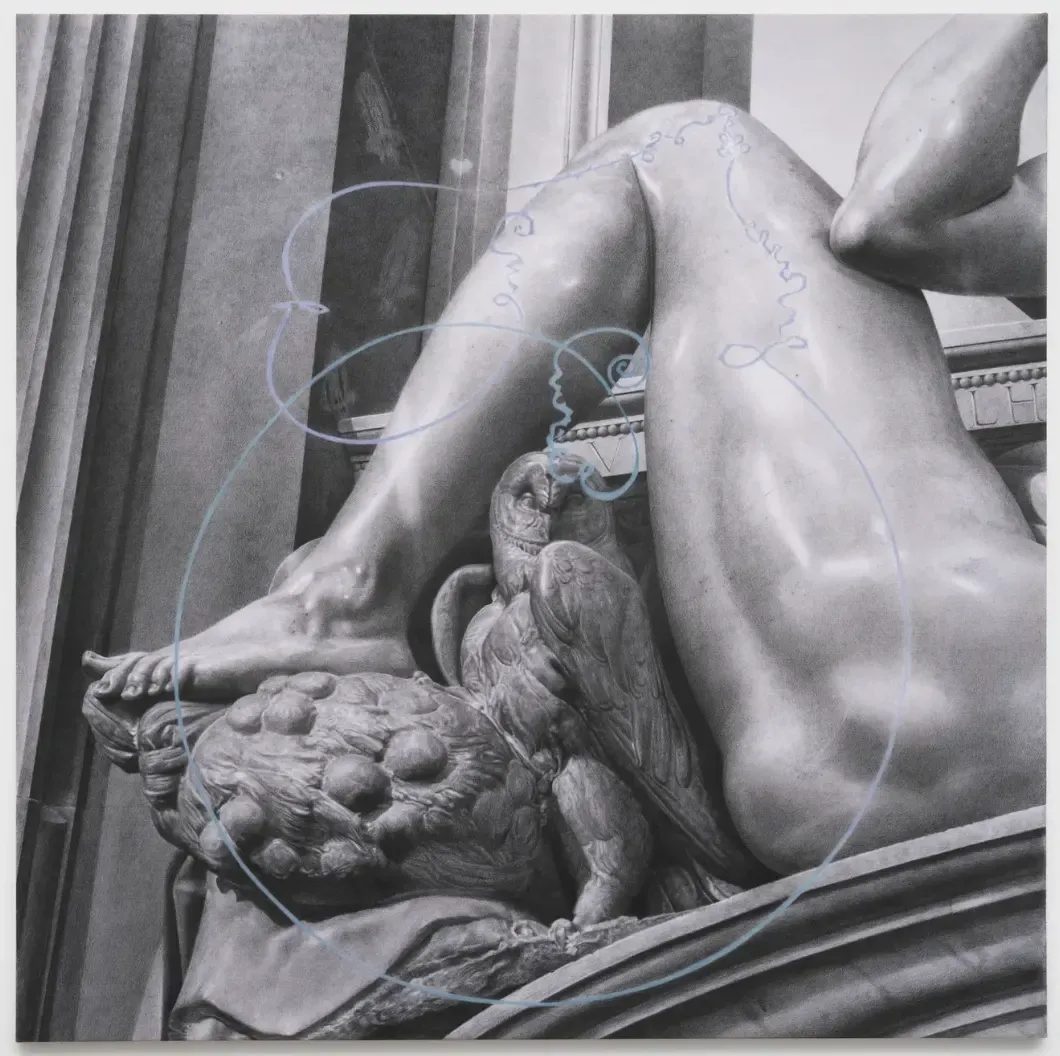
Zhang Yunyao’s exhibition ‘When the Surface Thinks’ comprises a suite of graphite drawings on felt, executed with near-photographic precision. A response to philosopher Paul Valéry’s ironic quip that ‘what is deepest in man is the skin – insofar as he knows himself’, Zhang’s work at once tests the limits of representation and demonstrates his mastery of his medium. Now based in Paris, Zhang graduated in 2007 from the College of Fine Arts at Shanghai Normal University in China, before moving to Europe in 2020. Subverting the traditions of Soviet Realism and the French Beaux-Arts in which he was trained, Zhang brings together depictions of classical statuary, ancient masks and illusionistic structures from engineering plans and medical science. Through techniques of tight cropping or mirroring, Zhang creates abstract yet eerily faithful renderings that exploit aesthetic ideals such as symmetry, true likeness and compositional balance. Unlike these conventions and ideals, however, the artist’s interest lies not in the painted subject, but in the act of withholding their identity and context to assert that meaning also accrues on the artwork’s surface.
Zhang works primarily with graphite pencil on white felt, an industrially produced textile that diverges from the paper and canvas of the Western academic tradition. Where oil allows for overpainting, felt traps the dark carbon media in its fibres, so that each of Zhang’s freehand marks cannot be revised. The process is accordingly laborious, requiring hundreds of hours of sustained attention. Layer by layer the composition is built, yet in absorbing light and embedding graphite, the material’s surface remains flat while its image feels weightless, free of the textural deposits oil paint would leave.
One of three series represented in the exhibition, ‘Connector’ (2022–present), and the visual puzzles that constitute them, foregrounds Zhang’s fascination with the idea of symmetry. In ‘Connector’, abstract forms proliferate from a central axis as if by the reflection of mirrors, producing mesmeric images that conjure endlessly regenerating forms in a moment of flux. The work of symmetry in the regeneration of forms, as Zhang appears to suggest, is both organic and machinic; ‘Connector VIII’ (2025), for example, recalls cells dividing under a microscope or a scan mapping brain activity, while ‘Connector XI’ (2026) echoes industrial engineering models or the diagram of a celestial wormhole.
Elsewhere, Zhang reappropriates classical subjects of the Western canon, citing their polymathic creators. With this, he gestures towards a set of long-established ideals – laws governing the creation of art as much as the fields of science or geometry – of realism, harmony and balance. In ‘Study in Figures (Ratio)’ (2025), Zhang’s composition shows only the leg of Michelangelo’s feminine Night figure which, housed within the walls of the Medici Chapel in Florence, appears with its male complement, Day. Cropped tightly, Zhang’s image of the sculpture’s leg becomes universal but feels strange and ambiguous, severed from its history and context, just as Michelangelo’s Night is from Day. The only instance of colour in the exhibition, the work is overlaid with fine blue lines that trace forms from the cartouches of Albrecht Dürer, the Renaissance theorist of ideal proportion. The title of the ‘Orthophoria’ (2023) works, meanwhile, refer to the ideal alignment of the eyes and behave as Zhang’s nod to the role of perception in notions of beauty, as well as the symmetrical musculature that conditions perfect sight. These works depict 18th-century sculptor Jean-Antoine Houdon’s lifelike studies of children, though Zhang renders both child and artistic hand unrecognisable by cropping to the sculpture’s torso.
This withholding of context, by delimiting what visual information is available, also extends to Zhang’s ‘Time’ series (2021–present). Here, the artist creates an archive of the human face by depicting Greek and Roman busts, East Asian funerary and theatrical masks, and other antiquities from around the world. Each work comprises a group of six to eight small panels isolating only the brows, eyes and noses of the artefacts, stripped of other identifying features that would help historically and geographically locate them. Cropping, in this instance, is Zhang’s way of gesturing to a new concept of anonymity emerging in contemporary society – one shaped by global events or technological advance, from the face masks worn during the pandemic to the facial recognition function of mass surveillance. At the same time, the antiquity of the original sources implies that humanity’s concern with anonymity is a longstanding one, integrally related to how we perceive, represent and, following Valéry, know ourselves.
Punctuating each ‘Time’ work is one panel bearing a six-digit date, formatted to resemble a digital clock. Paying tribute to On Kawara’s ‘Today’ paintings (1966–2014), Zhang completes each of these within the day it records, a constraint that has the work embedded in, and implicated by, time. While Kawara’s panels advanced day by day, Zhang’s advance year by year, the ancient faces of the groups set alongside digital timestamps, folding the distant and recent past into a single archive. As the ‘Time’ series suggests, linear time is but a construct, which memory, in its tendency to repeat and double back, refuses to follow. Multiple timelines also come to bear in Zhang’s ‘Connector X’ (2026), which considers the peculiar logic of memory. Its mirrored composition features a cross-section of a chair from Dia Beacon in New York, the institution where Kawara’s ‘Today’ paintings hang, and appears to reproduce Kawara’s series in miniature in its background, as small, dark rectangles suspended in a weightless, white void.
The enigmatic, panoramic work ‘When the Surface Thinks’ (2026) also draws from a place in the real world, in this case taking inspiration from the courtyard of a convent in Bruges, Belgium. Furthering the symmetry of his ‘Connector’ series, Zhang employs the visual device to prismatic effect, the convent wall and interlocking trees tessellating across the composition, with each brick and pollarded trunk forging a new link in the chain. Showcasing Zhang’s skilful handling of gradation and subtle tonal shifts, the exhibition exercises the perceptual faculties of the viewer, proposing new ways in which the painted or drawn image may be conceived. The visionary works of ‘When the Surface Thinks’ marshal illusionistic depth and true likeness through the humble means of Zhang’s graphite marks, attesting that the image is neither worldly material nor an event of perception, but rather, what the surface proposes and the eye resolves.
More to see
 On view
White Cube
Firenze Lai North and True North
The work of Firenze Lai (b. 1984, Hong Kong) explores the social, political and spatial subtexts that shape individual and collective psyches across both physical and virtual worlds.
 On view
White Cube
Gabriel Orozco Chronotopic
The exhibition juxtaposes over 200 new and existing works by the artist, including sculpture, painting, photography, assemblage and works on paper, and coincides with the 10th anniversary of the ‘Orozco Garden’, a permanent commission at the South London Gallery ...
 On view
Krakow Witkin Gallery
Jean-Michel Basquiat, Jenny Holzer, Barbara Kruger: Certain Terms, 1982–1986
The works included in this exhibition by Jean-Michel Basquiat, Jenny Holzer, and Barbara Kruger deploy language as a catalyst. Three distinct generational voices who came into their own in 1970s and early 1980s New York, all three artists engage the assumption of ...