January 17 – March 7, 2026
Sylvia Plimack Mangold: Tape, 1975–1986
Krakow Witkin Gallery
In Person Viewing:
10 Newbury Street
Boston, MA 02116
Online Viewing:
https://www.krakowwitkingallery.com/exhibition/sylvia-plimack-mangold-tape-1975-1986/
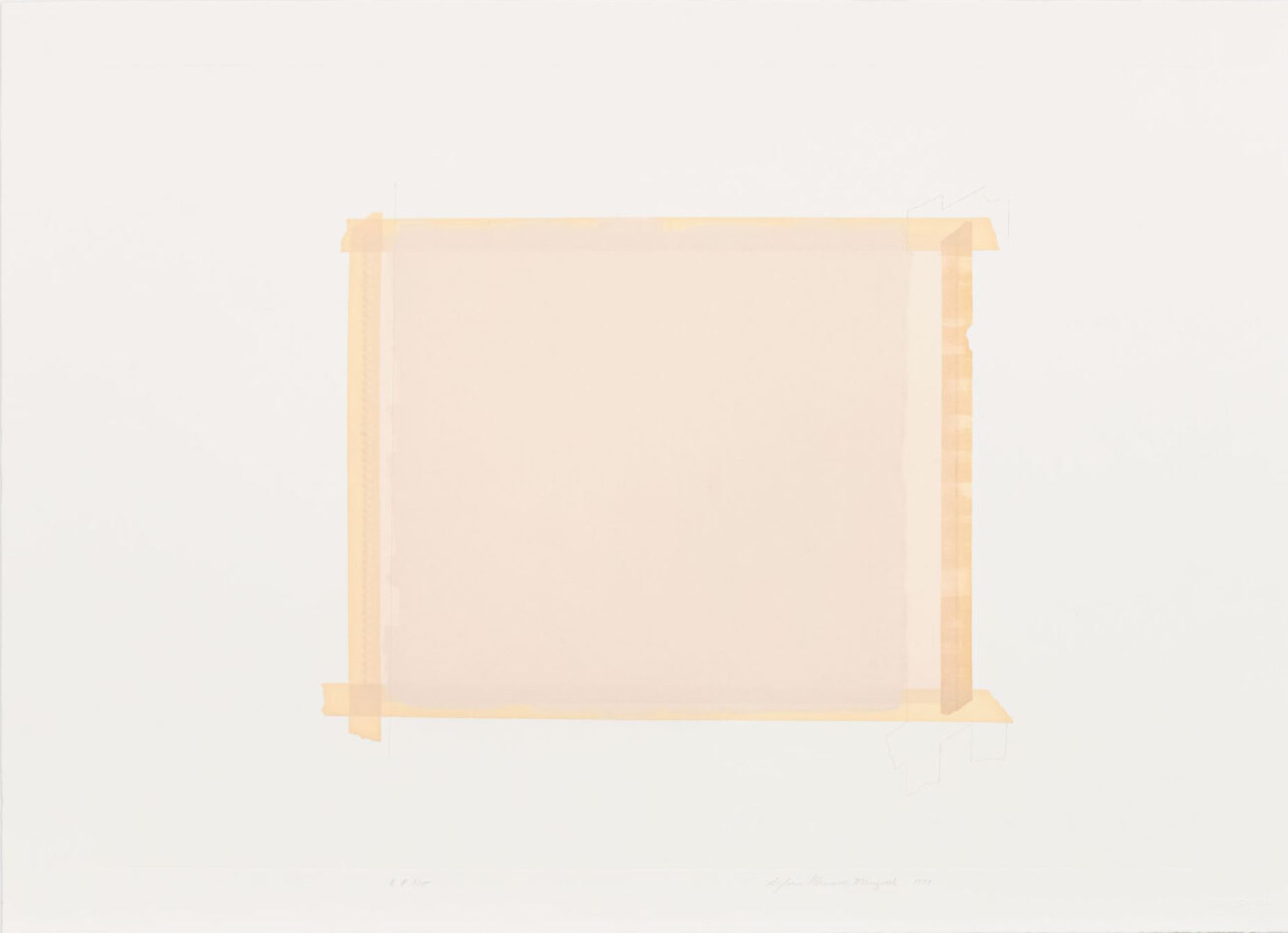
Krakow Witkin Gallery presents an exhibition of Sylvia Plimack Mangold’s works made between 1975 and 1986 that incorporate imagery of tape. From paintings of the depiction of bits of tape “adhering” imagery of paper to the surface of real paper or canvas, to the representation of tape as a cropping and/or masking tool, the current show gives viewers a deep look into how the artist progressed in her thinking and execution over the course of a decade.
For works made prior to those on view, the artist often employed adhesive masking tape as a technical tool in her work. As she spent more time with the material, she appreciated and focused on certain of tape’s physical and psychological qualities including its translucency that selectively obscures and transforms underlying forms and colors, its role as a connector between surfaces and objects, and its ability to frame and draw attention to both a picture plane and its boundaries. This interest led Plimack Mangold to pursue incorporating tape into her finished pieces by creating imagery of masking tape within her works.
She painted, drew, and printed what appears as a painter’s traditional use of tape, to temporarily mask an edge in the process of making an image. In addition, Plimack Mangold explored how, while the imagery of tape being used for cropping an image gives a central focus, the tape itself was of interest. This highlighted the process of how an artist decides how and what to include and, in emphasizing the edge, subtly undermined the center-weighted focus of representational art.
In all of this, she used actual tape to aid in the creation of imagery of tape, by masking off areas to make sharp-edged, thicker layers of paint to simulate the material itself. Even while using this technique, she never gave in fully to verisimilitude. The means of making the image remain in constant tension with the result.
Recognizing that tape, like floors she had painted in the 1960s and early 1970s, was part of the human, domestic world, the artist sought to introduce a contrast and an expansion of space. By the late 1970s, Plimack Mangold’s work frequently includes imagery of nature. Her explorations began with views through her studio window. The window soon no longer appeared in the work as the tape, itself, became the frame. From then on, she painted what she saw outside her studio: beginning with skies containing slow transitions of color from the horizon upwards; clouds; long vistas with barely discernible mountains and valleys; scenes in a nearby field; shifting ultimately to a focus on trees and their limbs. With all these images, tape was a constant, reminding a viewer of the deliberate and fabricated nature of a scene.
Sylvia Plimack Mangold’s works from 1975 to 1986, as exhibited in this show, display the psychological charge of the exchange between artist and viewer, human and nature, image and object, and process and result. As such, they are deliberately open-ended, experiential, and self-reflective, offering the viewer a journey of layered examination to mirror and continue the artist’s practice.