


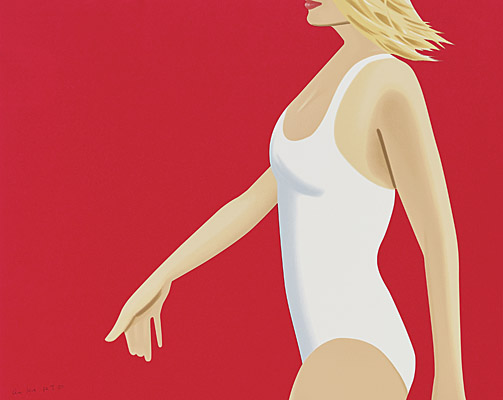
April 25 – May 30, 2026
Andy Warhol to Alex Katz
Galerie Boisserée
In Person Viewing:
Drususgasse 7-11
D – 50667 Cologne
Online Viewing:
https://www.galerie-boisseree.com/de/artists/warhol_katz_pop-art_2026.html
“Icons of Pop Art: From Campbell’s Soups to Coca-Cola Girls”
– Selected Prints and Sculptures
Hilton Kramer—the New York Times’ most renowned art critic from 1965 to 1982—once wrote in an article: “Pop Art is indistinguishable from the art of advertising.”(1) While this statement represented a critical perspective on this newly emerging art movement at the time, it nevertheless captures its essence perfectly. Unlike any style before it, Pop Art drew its subject matter from advertising, consumer goods, and mass-media celebrities from the worlds of film, music, politics, and public life. Pop Art embodied a certain conformism and employed a visual language that was not new, but rather already intimately familiar to the consumer. Previous art movements had emerged from—at least ostensibly—loftier aspirations: whether through the depiction of religious or mythological themes, or through a bourgeois perspective on the world. In later eras, artists operated independently of patrons, grappling instead with purely painterly questions. The Pop artists, however, were the first to turn their gaze toward everyday life. They elevated to the status of art those very things that were commonplace to people—objects and images they already knew all too well. Kramer’s observation remains valid today, given that the leading figures of Pop Art possessed extensive professional training in the fields of graphic design, advertising, and commercial art. Although they were—and remain—undeniably influential as artists, they drew their source material directly from their actual, day-to-day professional livelihoods. Roy Lichtenstein worked as a graphic designer and technical illustrator; Tom Wesselmann was a trained cartoonist; and Robert Indiana worked for daily newspapers, magazines, and in sales. Andy Warhol, however, undoubtedly possessed the most extensive professional training and the most successful non-artistic career of them all. He designed brilliant advertising posters for a major American shoe manufacturer. Consequently, he was familiar with the production processes for promotional materials—above all, the technique of screen printing—from the ground up. As early as the 1950s, he had already established an excellent reputation as an illustrator for glossy magazines, with a particular focus on fashion and lifestyle. What united them all was the shared ambition to evolve beyond mere commissioned work toward a free—indeed, artistic—engagement with familiar design principles.
Pop Art emerged—at the earliest—around 1952 through two parallel developments occurring simultaneously in Great Britain and the United States. In fact, these two currents evolved side by side, with only minimal mutual inspiration or influence. Although British Pop Art took shape somewhat earlier, the movement quickly became the very epitome of American art, and New York definitively supplanted Paris as the global center of the artistic avant-garde. Pop Art’s rise to international prominence was undoubtedly aided by the attention it garnered from collectors and patrons in what was then West Germany. These included patrons and collectors such as Gunter Sachs, and—above all—the collecting couple Peter and Irene Ludwig, who assembled the most significant collection of works in this new stylistic movement. By the time of documenta 4 in 1968, at the very latest, Pop Art had become firmly entrenched within the West German art scene. Unlike any other stylistic movement, Pop Art remains—to this day—strikingly modern, continuing to inspire contemporary artists. Among these are modern icons such as Jeff Koons, who captures the very essence of Pop Art by appropriating motifs drawn from kitsch and consumer culture; and Takashi Murakami, who draws upon the visually dynamic world of comics—much like Roy Lichtenstein, yet with a specific focus on Asian comics in the form of Japanese manga and anime culture. The artistic inspiration derived from comic strips is also readily discernible in the popular works of contemporary art superstars such as KAWS and Banksy. Julian Opie and Alex Katz are also among the artists whose works embody the stylistic principles of Pop Art.
The enduring appeal of Pop Art—undiminished to this day—is inextricably linked to the popularity of its key figures, foremost among them Andy Warhol. His renown remains high even today, extending far beyond the confines of the art world—a phenomenon that, apart from him, applies only to Picasso. This is undoubtedly attributable not merely to Warhol’s artistic output, but also to his significant media presence during his lifetime and his singular ability to fashion himself into a pop icon.